

The third short essay on sabbaticalling.
This is the place of our being that leads to the heart… What Andrew Carnegie meant in saying “My Heart is in the Work.”
I know the feeling as a kind of strength and sensitivity both. This moment happened for me in a talk I gave last week at the robotics conference in Pittsburgh; I felt such a sense of peace, calm, and a fizzing awareness and attentiveness—that test-taking buzz and the hum just before a play-off game of hockey—and yet I descended from the stage in the hanger-sized convention hall with a gentleness I have never felt after a talk before. Years ago, during those hectic days applying to faculty positions I would end an hour long presentation with my arm pits drenched under my dress shirt. Once I had a faculty position, I would end my lectures in front of 100 students and collapse into my little couch in my office.
A Turkish professor I have recently become acquainted with said to me after my robotics keynote, “geçmiş olsun,” a phrase we use for illness and accidents, literally “may it be passed.” I was so taken aback and confused I asked him to explain twice (had someone died?!) to get that he meant it for my having passed the ordeal of the public performance in front of a room of thousands. Oh! This was nothing! I felt like I could go on for another two hours.
Others have called such moments peak experience or flow—and I have had those, too—but there is something different about this, and for it’s name I will continue to take freely from Joseph Campell’s language (and Michael Mervosh’s continued articulation) of the Hero’s Journey. Here is the Boon. In contrast to the high of a peak experience (after which the inevitable crash—the low), the boon is an abiding quality. Once tasted, the flavor lingers. There is a deep confidence. I know I can do this again because it is not a skill any longer: this is who I am now.
My keynote was successful because I let myself be me as much as I could.
I love dialogue, and so, I cut my talk short: I spoke for half the allotted time and gave the other half over to comments and questions.
I love collaborating and the student-professor relationship, so I asked my student assistant, Maggie Guo, to join me in the presentation.
I love show-and-tell—actually I love handle-and-tell because when a child says “let me see that,” their arms are outstretched, hands open to grasp. We grasp new concepts most readily by literally grasping, so I brought a prototype of the membrane tensegrity replication and Maggie toured in around the hall to let audience members touch the thing I had just made (what I was writing about last week).
I love the long deliberately-desired awkwardness of the silence before a statement well stated, so I waited for the audience to speak (it felt like a minutes of dead air, but was probably 20 seconds).
I love the long meandering conversations we can enjoy in reconnecting (networking also means re-connecting!) with colleagues and friends from a lifetime ago, so I chose to join my abidingly kind former mentor, Prof. Marcia O’Malley, for lunch on the high patio of the convention center. Overlooking the Alleghany river, the stadiums, and the Appalachian hills beyond, we spoke about work and life while carefully picking at the boxed salad which threatened to fling itself saucily over our professorial finery.
I love learning to learn and the basic relationship to not knowing that is demanded of us, so I made my talk based on a single slide (not counting the title slide): a quadrant diagram about types of research, or said differently, modes of thinking.
Here is that chart again:
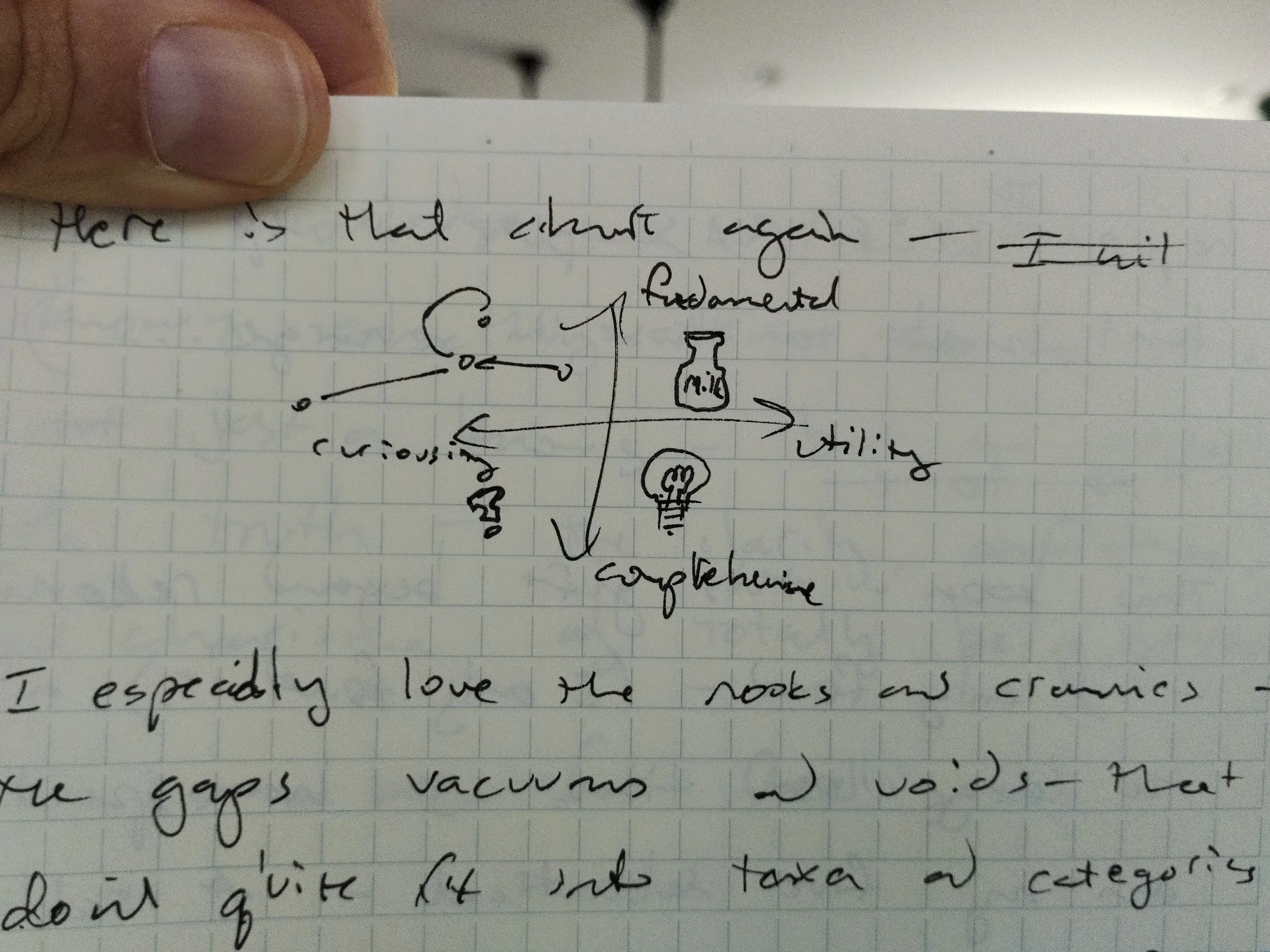
The x axis is labeled: Curiosity (left) <---> Utility (right)
The y axis is labeled: Fundamental (top) <---> Comprehensive (bottom)
Bottom right has a light bulb. Top right has a bottle of milk. Top left has a quantum particle collision. Bottom left has a question mark.
I especially love the nooks, the gaps, vacuums, and voids that don’t quite fit into the taxa and categories and logical frameworks—the WEIRD, the Alien, the Unknown. My favorite part of this quad-chart is the names quadrant (labeled “No-No” from the Wikipedia article: link), so that is where I ended my talk and handed it over to the audience. Those who spoke into the space I and the empty quadrant left open brought in asteroid mining, surgical robots, personal flying machines, gyrocopters, bioinspiration, tensegrity, and (soft) robots.
This boon—this gift beyond reckoning—I only found after the long lost time I have spent on my five year (so far) sabbatical. A sabbatical is a time to leave the systems – the habits – the routines – of home. And what do we leave all that comfort and treasure and power for? Ultimately, we leave it to learn something true about ourselves—why am I the way I am? What am I bringing to the world through my work? What kind of scientist/artist/engineer/designer am I? What do I care about more than anyone else I know?
Bruce Lee said all knowledge is self-knowledge. The boon is knowing something true—not just a knowing, but an experience of truth: the clarity, confidence, charisma of totally being yourself.
—it’s a beautiful feeling—